
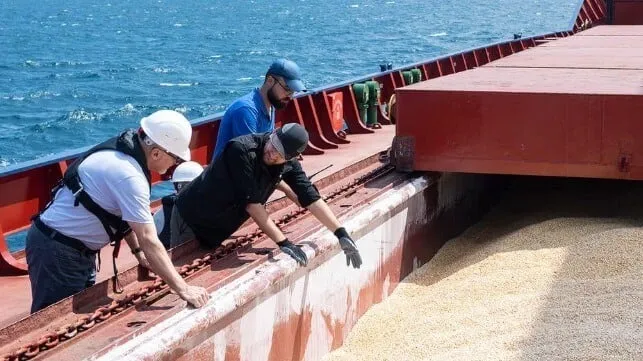
Russia is reviewing proposals to ensure safe grain transport across the Black Sea, senior Foreign Ministry official Alexander Alimov told Interfax on Monday, while saying he sees no prospect of reviving the Black Sea grain deal in any form.
Russia is reviewing various proposals to ensure safe grain transport across the Black Sea, Interfax reported on Monday, but a senior Russian Foreign Ministry official said he sees no prospect of reviving the Black Sea grain deal. Alexander Alimov said Russia is in dialogue with Turkiye and other countries on the issue.
“We are in dialogue with all countries – and by that I mean Turkey as well. And not just with Turkey, we are discussing this issue with various countries, but so far I do not see any prospects for reviving the grain deal,” Alimov was quoted as saying. A second rendering of his remarks says he saw no possibility of reviving the deal “in any form” and that the United Nations had been unable to guarantee commitments on Russian agricultural and fertiliser exports.
The original Black Sea Grain Initiative was brokered in July 2022 by the United Nations between Turkiye, Russia, the UN and Ukraine, and one secondary account puts its total at nearly 33 million tonnes of Ukrainian agricultural exports. Russia left the arrangement in summer 2023, citing continued hindrance to Russian food and fertiliser exports. On Monday, Reuters market reporting also noted that Chicago wheat futures turned lower amid the new proposals to reopen Black Sea grain shipping.
The remarks and the proposals come from Interfax as carried by Reuters and Devdiscourse, and Alimov's exact title varies between outlets, so he is described here simply as a senior Russian Foreign Ministry official. Considering proposals for safe shipping is not the same as reviving the deal: Alimov explicitly rules out revival, and the fall in wheat futures is a market reaction, not proof that an agreement is near.
The distinction matters for shippers and importers. A workable arrangement for safe passage, short of a revived deal, would still lower the risk premium on Black Sea cargoes, while a revived deal would carry inspection and export guarantees that Russia says it will not accept again.
The next question is whether the proposals under discussion produce such an arrangement. Until a proposal is accepted and ships move under it, the Black Sea grain trade remains in the same position it has been in since Russia left the deal in 2023: possible, but without the guarantees the deal once provided.