
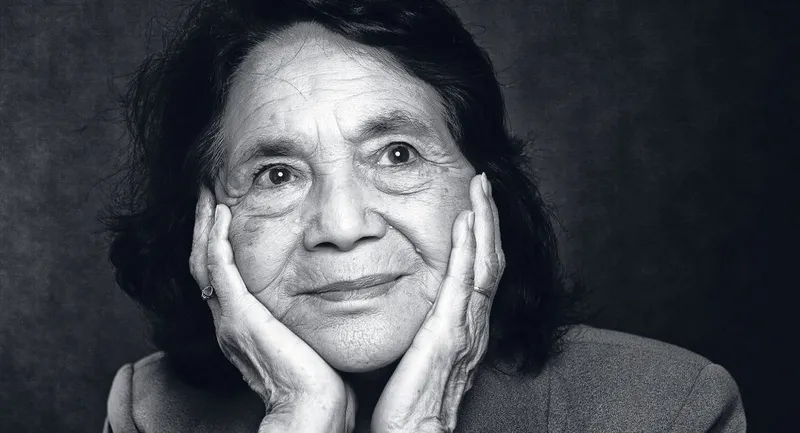
Dolores Huerta, who co-founded the United Farm Workers with Cesar Chavez and gave the labour movement its rallying cry 'Sí, se puede!', died on October 28 at her home in Bakersfield, California, at 96, her family said.
Dolores Huerta, the labour organiser who co-founded the United Farm Workers with Cesar Chavez and gave the movement its rallying cry 'Sí, se puede!', died on Wednesday, October 28, at her home in Bakersfield, California. She was 96. Her family said she died of cancer, surrounded by family, according to family spokesperson Erik Olvera, and asked for privacy as they grieve.
Born Dolores Clara Fernandez on April 10, 1930, in Dawson, New Mexico, Huerta moved to Stockton, California, at age 3 and briefly taught school in the 1950s, where seeing hungry farmworkers' children coming to school pushed her into organising. She founded the Stockton chapter of the Community Service Organization in 1955, leading voter registration drives, and joined forces with Chavez in 1962 to build what became the United Farm Workers. Her work helped win the Delano grape strike of 1965 to 1970 and the first binding collective bargaining agreement for farmworkers in United States history, and she helped pass California's Agricultural Labor Relations Act in 1975, giving farmworkers the right to organise and bargain collectively.
Her influence extended well beyond the fields. She was one of the few women lobbyists of the late 1950s and early 1960s, fought successfully for changes including allowing driver's licence exams in Spanish and disability insurance protections for agricultural workers, and remained active into her 90s, marching and speaking on race, poverty, women's rights and LGBTQ rights through her Bakersfield-based foundation. President Barack Obama presented her with the Presidential Medal of Freedom in 2012, joking that he had borrowed her slogan for his 2008 campaign.
The death was announced by her family and reported by the Associated Press and other outlets on October 28, with the cause given as cancer and the place as her Bakersfield home; those core facts are consistent across the family statement, the Associated Press account and the foundation obituary summarised in local coverage. One part of her later story is reported with attribution rather than as an uncontested record: this year Huerta told the New York Times that Chavez had sexually abused her in the 1960s, a disclosure she said she had kept silent about for decades for fear of harming the movement. This piece reports that disclosure as her account to the Times, as the outlets carrying it do, and does not present it as an adjudicated finding.
Maryland Governor Wes Moore said in a statement that Huerta led strikes and boycotts for worker rights, helped pass the landmark law giving farmworkers the right to bargain collectively, and inspired generations of organisers and public servants, adding that the country is a better place because of her advocacy for workers, women and immigrants. Her family said it would follow up with plans to recognise and celebrate her life and legacy.
The next step is the family's announcement of those plans to recognise her life, while the union she helped build and the foundation bearing her name carry forward the organising work she began in the Central Valley more than six decades ago.