
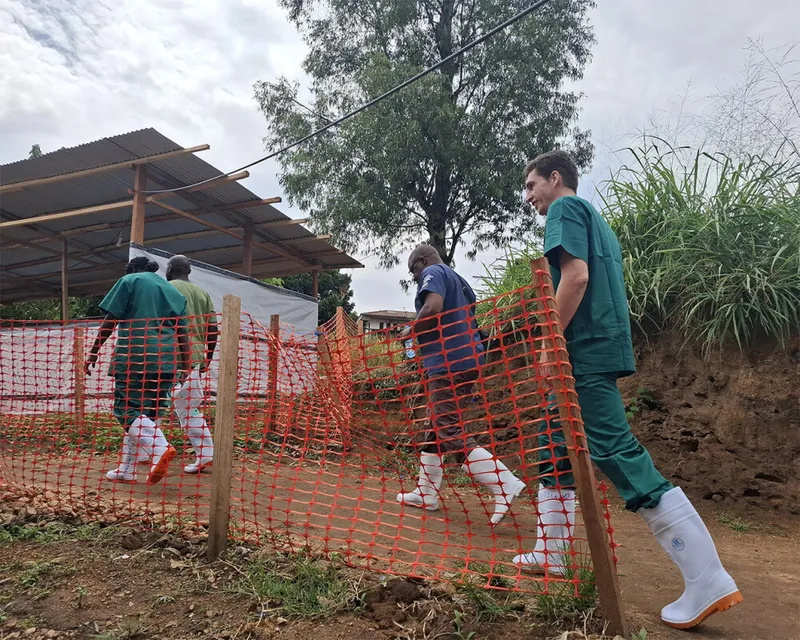
Four studies in Bunia are testing a vaccine, vaccine candidates and drug combinations against the Bundibugyo strain; none has yet established a proven treatment or protective vaccine.
Clinical research in Bunia is testing several ways to reduce the toll of the Democratic Republic of the Congo’s Bundibugyo Ebola outbreak, but the studies are still gathering evidence rather than offering a proven vaccine or treatment. Le Monde reports that the BRAVO study, launched by Médecins Sans Frontières and the Congolese Ministry of Health on September 19, is evaluating Ervebo among frontline workers. The vaccine is licensed for the Zaire strain, not Bundibugyo, so its protection against the strain driving this outbreak remains unproven.
By October 27, about 2,030 people had joined BRAVO, which aims to reach 20,000 participants. The first results are not expected before spring 2027 because researchers need to compare confirmed infections among vaccinated and unvaccinated participants. The separate Tumaini platform, launched in Bunia on October 23, is designed to assess multiple vaccine candidates under one protocol. On November 4, WHO said experts had recommended adding Oxford and Serum Institute’s ChAdOx1 candidate and Moderna’s mRNA-1469 candidate, subject to national approvals.
A treatment study, PARTNERS, is testing the monoclonal antibody MBP134 and the antiviral remdesivir, separately or together, alongside standard care. The Institute of Tropical Medicine says the trial is a collaboration with the Congolese National Institute for Biomedical Research and the University of Oxford, with WHO support. Le Monde reported that MBP134 had been administered to 755 patients by October 27, but clinicians cautioned that recoveries cannot yet be attributed to the study drugs rather than patients’ own immune responses.
A fourth study, Ebo-Pep, is examining obeldesivir and remdesivir as preventive options for high-risk contacts, including pregnant women and children. WHO’s November 6 situation report recorded 10,668 confirmed cases and 5,198 deaths across 67 health zones in eight DRC provinces as of November 3. The central distinction is important: the research is advancing, but no vaccine specifically licensed for Bundibugyo or proven treatment was available when these reports were published.