
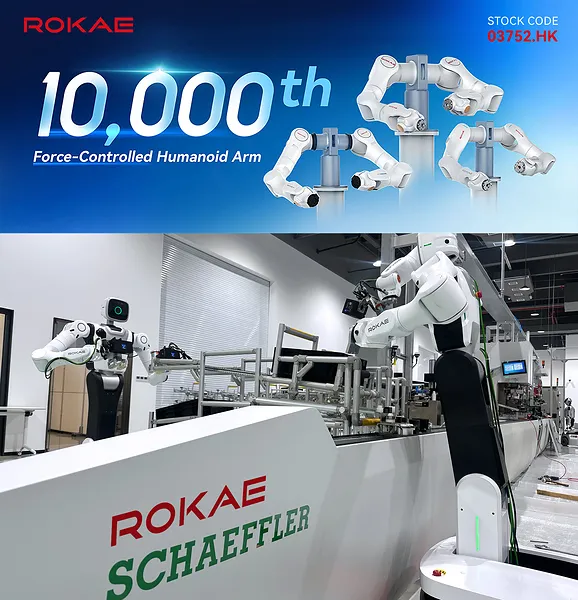
Chinese robotics firm ROKAE has delivered its 10,000th humanoid force-controlled arm, a milestone in the commercial use of robotic hardware for embodied AI, with its robots already working on an assembly line at Schaeffler's Lighthouse Factory in China.
ROKAE Robotics has delivered its 10,000th humanoid force-controlled arm, marking a milestone in the commercial deployment of robotic hardware for embodied artificial intelligence, the company announced on October 27.
The milestone unit rolled off the production line at ROKAE's manufacturing base in Shandong province in September. The figure covers the company's humanoid force-controlled arm product line alone, separate from its industrial and collaborative robots, which are deployed across more than 40 countries and regions. More than 80 industrial partners have integrated the arms into production applications, according to the company.
The arms are already working in a real factory setting. At Schaeffler's Lighthouse Factory in Taicang, five ROKAE Helios wheeled humanoid robots fitted with AR Series arms work on an assembly line for humanoid robot components, handling parts, assembly and inspection. The AR Series arms provide force control at every joint, and a compact MAC controller measuring 213 by 145.5 by 45 millimetres can control all seven joints of a single arm, all 14 joints across a pair of arms, or more than 20 joints across a humanoid robot.
The delivery count, the deployment details and the technical specifications come from ROKAE's own announcement, which is the primary source for this story, and no independent verification of the 10,000-unit figure was available at publication. Founder and chief executive Tuo Hua said the number matters less than the trust behind it, adding that reaching 10,000 units means delivering consistent performance across hardware, control algorithms and manufacturing at scale. ROKAE, founded in 2014 and listed in Hong Kong under stock code 3752, says it serves more than 1,000 enterprise customers across more than 40 countries.
The milestone matters because it moves humanoid hardware from one-off demonstrations toward repeatable factory use: the same arms that hit a production count are the ones handling parts on a working line. Whether that translates into wider adoption will depend on whether other manufacturers follow Schaeffler's example and put the arms into production rather than pilot projects.