
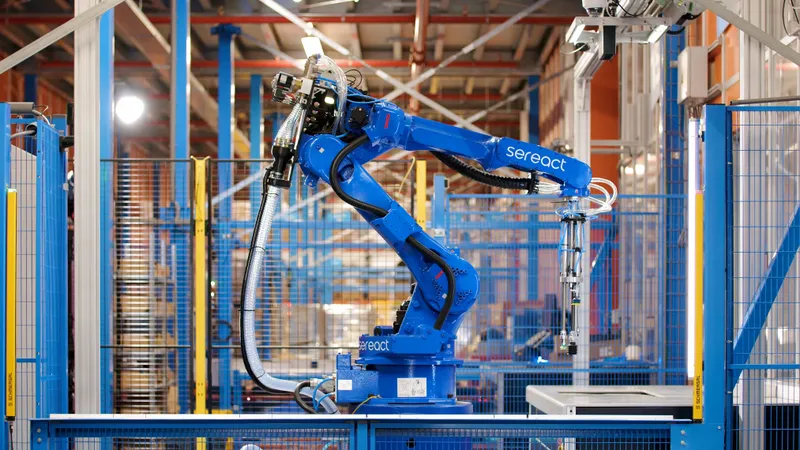
Otto Group and Sereact will deploy AI-controlled dual-arm robots at a Polish logistics centre to inspect and sort returned orders, starting with ten systems and rising to 25 if early results hold.
Otto Group and robotics software company Sereact announced on October 28 a two-phase plan to use AI-controlled robots for one of retail's hardest manual jobs: inspecting and sorting returned customer orders. Ten dual-arm systems will be deployed first at Otto Group's logistics centre in Poland, with 15 more to follow based on initial results, taking the fleet to 25.
The robots run on Cortex, Sereact's physical AI model, which is built to grasp, identify, assess and route items it has never encountered before, without product-specific teaching or a fixed item catalogue. That matters for returns, where items arrive folded, crumpled, repackaged and in constantly changing assortments that defeat traditional automation, which depends on known products presented in predictable ways.
Cortex is trained and validated with NVIDIA Isaac Sim, NVIDIA Isaac Lab and NVIDIA Cosmos, turning real picks from the returns line into thousands of simulated variants across garment states, packaging, materials and lighting. New policies are post-trained on NVIDIA Blackwell graphics processors and tested against held-out cases before reaching the robots, so a fix for an item a robot struggles with can return as a tested update within days rather than weeks.
The announcement is a company plan, not a completed deployment: the second phase depends on the first phase's results, and Otto Group will only weigh a broader rollout across its logistics network if the second phase succeeds. The companies' own release puts the project in the context of Otto Group's medium-term commitment to invest 350 million euros in technology and AI, and Sereact's $116 million Series B funding round in 2026.
Otto Group supply chain chief Martin Umland said returns are notoriously hard to automate and that the project will show, at real scale, how far physical AI can take the process. Sereact chief executive Ralf Gulde said a robot that only knows yesterday's catalogue is of little use in a returns centre, because Cortex has to deal with whatever comes out of the next parcel.
Under the robotics-as-a-service model, Sereact will operate and maintain the systems while Otto Group employees shift from repetitive grasping and lifting to supervision, exception handling and final quality decisions. Whether the systems meet the reliability, flexibility and quality standards for wider use is the question the staged rollout is designed to answer.