
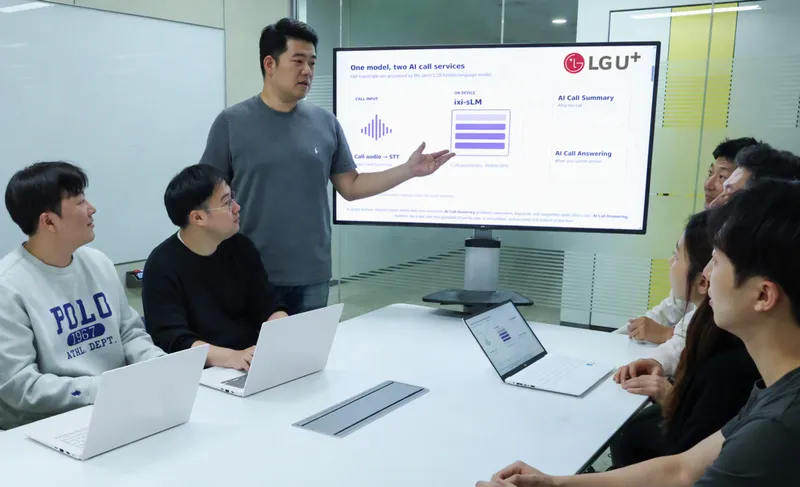
LG Uplus says two of its papers on AI token optimisation were accepted for a NeurIPS 2026 workshop, with smartphone tests showing about 4.5 times faster processing and 77% lower battery use.
LG Uplus has won recognition at one of the world's top artificial intelligence conferences for token optimisation technology that speeds up AI responses while cutting battery consumption, the company said on 29 October. Two of its papers on AI token optimisation were accepted for the On-Device Intelligence Workshop at NeurIPS 2026, which will be held in Sydney, Australia, in December.
Tokens are the units of data AI uses to interpret a question and generate an answer, and the faster and more efficiently they are processed, the quicker the response and the lower the power and resource use. LG Uplus applied its technology to the smartphone environment, studying how to run and train small language models efficiently with limited memory and power. It first developed a small language model for use in call services, then optimised it for smartphones using model compression and inference acceleration techniques.
The result, according to the company, was a roughly 4.5-fold increase in processing speed and a reduction in battery consumption of about 77% compared with conventional methods, while maintaining performance on par with the latest cloud-based AI. LG Uplus also studied technology that trains AI directly on a smartphone without sending personal data outside the device, with tests showing accuracy on par with models trained on servers.
The acceptance of the papers is confirmed by the company's announcement as reported by the Seoul Economic Daily, and the performance figures are the company's own test results, not independently verified measurements. The story therefore reports the 4.5-fold speed and 77% battery claims as company figures, and the acceptance itself as the verifiable news.
Chief technology officer Lee Sang-yeop said the acceptance recognises research on running and training AI quickly and efficiently even in constrained environments, and that the company will apply the technology to actual services so customers can use AI more quickly and conveniently, expanding the research to server environments going forward.
The workshop in Sydney in December is the next dated step, where the papers will be presented alongside work from researchers at companies such as Google, Meta and OpenAI and leading universities.