
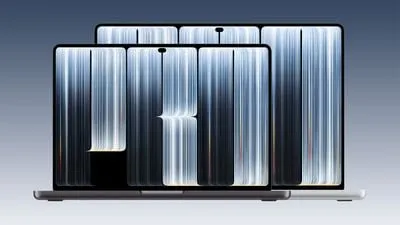
Apple announced its first Mac laptop with a touchscreen on 28 October, a MacBook Pro with a tandem OLED display, M5 Pro and M5 Max chips, and a 6 November availability date.
Apple announced on 28 October its first Mac laptop with a touchscreen, a MacBook Pro built around a new PROLED XDR display, in 14-inch and 16-inch sizes. The touch sensor is built directly into the display panel, and the camera notch of earlier models is replaced by a Dynamic Island.
The tandem OLED panel offers up to 2,000 nits of peak brightness, a contrast ratio of 10,000,000 to 1, ProMotion refresh rates up to 120 hertz, and coverage of the P3 and Adobe RGB colour spaces, with an optional nano-texture finish. The machines run on Apple's M5 Pro or M5 Max chips, support up to 128 gigabytes of unified memory and up to 16 terabytes of storage, and weigh 3 pounds for the 14-inch model and 4 pounds for the 16-inch model.
Pricing starts at $2,899 for the 14-inch M5 Pro model and $3,399 for the 16-inch M5 Pro model, while M5 Max models start at $4,499 and $4,799 respectively. The new machines reach customers and stores on Friday 6 November.
The specifications, sizes and prices are consistent across Apple's announcement as reported by MacRumors, MacObserver and Digital Trends, which all describe the same tandem OLED panel, chip options and starting prices. Apple has not framed the touchscreen as a change to how macOS itself works, and the reporting does not claim that it has.
The move ends one of the longest-running lines in Apple's product history: the Mac stayed touch-free while the iPad and iPhone built their identities around touch, and Apple had long argued that a touchscreen did not belong on a laptop. Putting touch into its most powerful portable, rather than a cheaper model, signals that the company now sees touch as a professional tool, not a compromise, and it puts direct pressure on high-end Windows laptops that have offered touchscreens for years.
What matters next is whether software follows hardware. The display, chips and prices are settled; the open question is how far Apple's own applications and third-party developers go in building touch-first workflows for a machine whose buyers have spent years working with a keyboard and trackpad alone, and that answer will only emerge once the machines are in use after 6 November.