

Webb spots 104 flickering stars in distant Dragon galaxy, more than doubling record
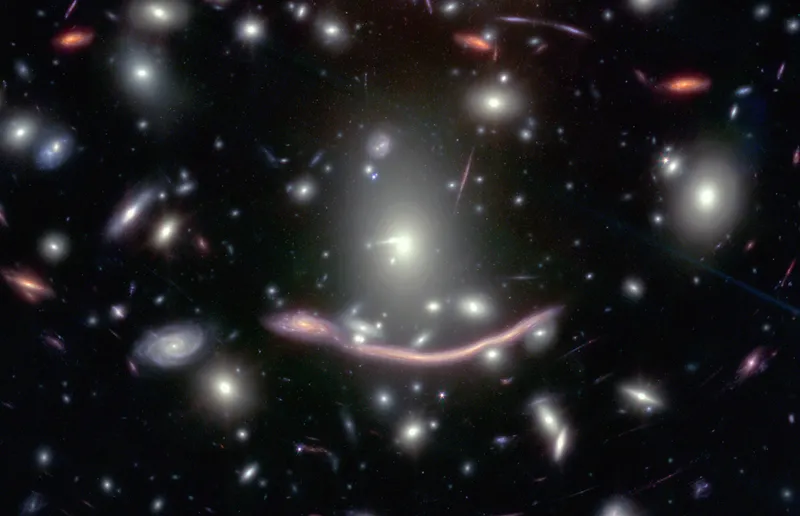
The James Webb Space Telescope counted 104 magnified stellar events in the Dragon galaxy, a lensed arc 6.5 billion light-years away, more than doubling the previous record for a single galaxy.
Story So Far
Astronomers using the James Webb Space Telescope have counted 104 magnified stellar events in a single distant galaxy, more than doubling the previous record of 44 and opening a new way to probe what the galaxy's light can reveal about dark matter.
The galaxy, known as the Dragon, is a stretched arc of light about 6.5 billion light-years away, magnified by the massive cluster Abell 370 sitting between it and Earth. The team, led by José María Palencia of the Institute of Physics of Cantabria, compared Webb images taken between 2022 and 2024 and picked out points of light that changed brightness from one visit to the next.
The work appeared in the journal Astronomy & Astrophysics on 30 September. Each flicker is a single star, briefly brightened many times over as the cluster's gravity bends its light, and the tally of 104 events is the largest statistical sample of its kind at a redshift of about 0.725.
The paper is peer-reviewed, and the count of 104 events against the earlier 44 was reported by Phys.org. The study discusses fuzzy dark matter as one possible reading of the pattern, but it does not claim a detection of any dark matter particle, and the nature of dark matter remains unsettled.
With more than a hundred events in one galaxy, astronomers can now test models of how stars are distributed and how dark matter is arranged in the lensing cluster, rather than arguing from a handful of examples. Further Webb visits to the Dragon could sharpen those tests, and the same method can be turned on other lensed arcs.
Keywords
Tags
Source
Reported by Phys.org on Sunday; paper in Astronomy & Astrophysics