
- Health
- Breaking

Samsung Bioepis says Keytruda biosimilar matched original in Phase 3 lung cancer trial
Samsung Bioepis said its Keytruda biosimilar SB27 matched the original drug in a global Phase 3 trial in 555 lung cancer patients, presenting the full dataset at SITC 2026 in Phoenix, after filing for approval in South Korea in August and with the US FDA in October.
Story So Far
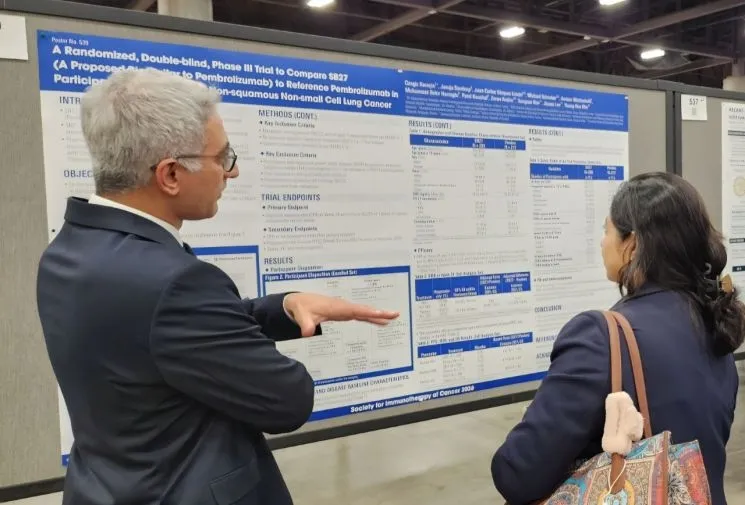
Samsung Bioepis said its proposed biosimilar of Keytruda matched the original cancer drug in a global Phase 3 trial, presenting the full dataset at the Society for Immunotherapy of Cancer meeting in Phoenix on November 6 and announcing the results on November 9.
The trial enrolled 555 patients with metastatic non-squamous non-small cell lung cancer across 14 countries, randomised evenly to SB27 or Keytruda, each given intravenously every three weeks alongside chemotherapy. After 24 weeks, tumours had shrunk in 34.6% of patients on SB27 and 37.9% on Keytruda, and the 90% confidence interval for the ratio between them, 0.737 to 1.071, sat entirely inside the pre-set equivalence margin of 0.712 to 1.405, the formal test for biosimilar equivalence. Secondary measures including progression-free survival, duration of response and overall survival came out similar, safety looked comparable, and no patient developed neutralising antibodies.
Keytruda is the world's top-selling immuno-oncology drug; Seoul Economic Daily put its global sales last year at $31.7 billion. Samsung Bioepis had already reported in June that both its Phase 1 and Phase 3 studies of SB27 had met their primary endpoints, and it presented the Phase 1 pharmacokinetic data at the ESMO congress in Madrid in late October. The company applied for approval in South Korea in August and filed with the United States Food and Drug Administration last month; the American application, made public on October 30, covers 18 indications.
The trial numbers are consistent across the company's June release, which gives the same response rates, confidence interval and equivalence margin, and independent coverage of the Phoenix presentation. The Seoul paper's account of the secondary endpoints and safety matches the company's statements, and the filing dates are confirmed by the company's own third-quarter update and by the October 30 American filing. One figure in the story stands on a single source: the $31.7 billion sales figure comes from Seoul Economic Daily alone. The claim that this is the first full Phase 3 disclosure for any Keytruda biosimilar has not been independently confirmed.
If the FDA review runs its standard course, a decision could come in the fourth quarter of 2027, about a year before the core American patent on Keytruda's intravenous formulation is expected to expire in December 2028. A biosimilar would give health systems a cheaper version of one of the most expensive drugs in oncology. "We met the primary endpoint in a large-scale global Phase 3 trial, confirming SB27's clinical equivalence and consistent safety profile," said Shin Dong-hoon, the company's head of clinical development.
The company also said it would supply the drug free for up to a year so trial participants can keep receiving it after the study ends, which pushes the trial's listed completion date to next August. That extension, the company said, is not a delay but a way to gather safety data over a longer period.