
- Technology
- Breaking

Prosecutors say ex-OpenAI engineer used Codex to tune a hidden office recorder
Prosecutors say former OpenAI engineer Abdulrahman Alfozan used the company's Codex tool to add voice detection to a hidden office recorder and organise the recordings, according to a new federal court filing.
Story So Far
What happened
Federal prosecutors told a San Francisco court on Monday that Abdulrahman Alfozan, a former OpenAI engineer, used OpenAI's own coding tool Codex to improve a hidden recording device planted in the company's headquarters. According to a court filing first reported by The New York Times, Alfozan used his wife's account to prompt Codex to add a voice-detection skill so the device would only record speech, and used it to organise the resulting recordings in Dropbox.
Why it matters
The case puts an AI coding agent at the centre of a federal wiretap prosecution, and it raises the stakes of an already serious case: prosecutors say the recordings captured dozens of September meetings, some involving what may be trade secrets, a meeting between OpenAI and a foreign government, and conversations with customers and lawyers. The Codex prompts themselves are now part of the prosecution's evidence.
What we know
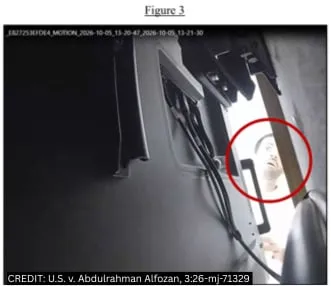
Investigators say the device, wrapped in toilet paper and installed behind a television in an executive conference room at OpenAI's San Francisco headquarters around September 28, was a small Seeed Studio board that also captured low-quality video. They recovered more than 160 hours of audio from Alfozan's computer, along with photos of a document marked confidential about a strategic partnership. Alfozan, 35, was arrested on October 9, fired the same day, and pleaded not guilty on November 6 to one count of intercepting oral communications, which carries up to five years in prison. A trial is set for January, and he is being held without bail after a judge found him a flight risk.
Our perspective
The two sides describe the same facts very differently. Prosecutors say Alfozan was in frequent contact with people affiliated with the Saudi government, which offered to guarantee a $1 million bond, and that a one-way flight was booked for his wife and child days after his arrest. His lawyer says he has no special or covert ties to the Saudi government, and has described him as an overly curious tinkerer, denying that he was stealing trade secrets for Saudi Arabia.
How we know?
This account rests on the November 23 filing as reviewed by The New York Times and Bloomberg, with Business Insider and Gizmodo reporting the same filing, and the underlying case is USA v. Alfozan in the US District Court for the Northern District of California.
Original reporting
Independent corroboration
Verification notes
- Confirmed: the filing, its Codex claims, the device, the 160-plus hours of audio, the October 9 arrest, the November 6 not-guilty plea and the January trial date are reported consistently by the Times, Bloomberg and Business Insider accounts of the filing.
- Reported: that the recordings involved a foreign-government meeting and material that may be trade secrets is the prosecutors' characterisation in the filing, not a court finding.
- Unconfirmed: whether any trade secrets were transmitted to anyone, which Alfozan denies.
Keywords
Tags
- Technology
- United States
- OpenAI
- Codex
- Espionage
- Court