

October was the warmest on record and 2026 is set to be the second-hottest year, Copernicus says
October 2026 was the warmest October on record at 15.35C, Copernicus said, and 2026 is now most likely to finish as the second-warmest year on record, virtually certain to exceed 1.5C above pre-industrial levels.
Story So Far
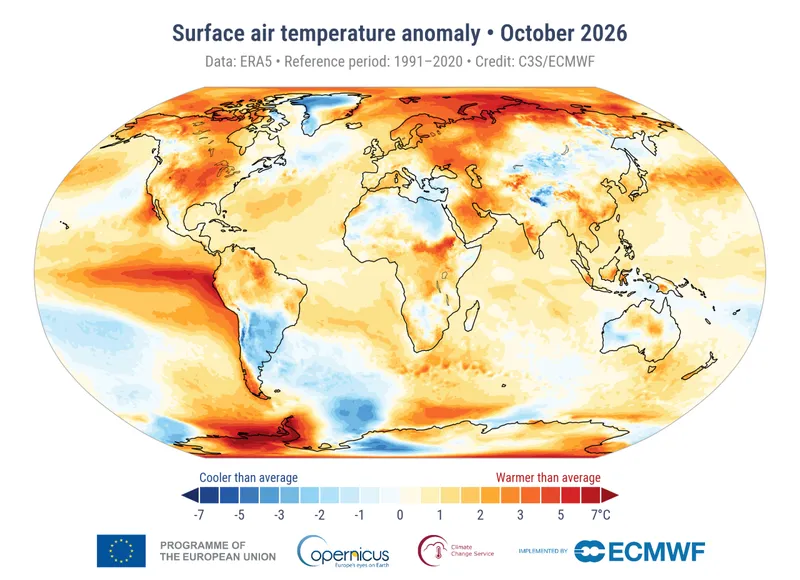
October 2026 was the warmest October on record worldwide, the European Union's Copernicus Climate Change Service said, and 2026 is now on course to become the second-warmest year ever recorded. The global average surface temperature reached 15.35 degrees Celsius, 1.75 degrees above the pre-industrial average for the month.
October ran 0.90 degrees above the 1991-2020 average for the month, beating the previous October record set in 2023, and it was the third consecutive month above 1.5 degrees. Across the first ten months of the year, 2026 ranks as the second-warmest on record, 0.64 degrees above the 1991-2020 average and just 0.07 degrees behind the same stretch of 2024. Copernicus puts the chance of 2026 finishing as the second-warmest year at about 80 percent, with about a 20 percent chance of matching or beating 2024.
A strengthening El Niño is doing much of the pushing. Sea surface temperatures in the Niño 3.4 region of the Pacific hit an all-time high of 29.94 degrees in October, and the World Meteorological Organization says the event is strengthening rapidly, is expected to peak in December and is now almost certain to persist through February 2027. Average ocean temperatures outside the polar regions also set an October record, the fourth consecutive month to do so.
The figures come from Copernicus's monthly bulletin, built on its ERA5 reanalysis, and the headline findings match the accounts carried by AFP and Reuters. The annual ranking is a model prediction rather than a measurement, since two months of data are still to come, and the same model leaves open a roughly one-in-five chance that 2026 overtakes 2024 as the warmest year on record.
Copernicus also says 2026 is virtually certain to exceed 1.5 degrees above pre-industrial levels for the calendar year, the second year to do so after 2024, and the four-year average from 2023 to 2026 is expected to pass that mark too. The Paris Agreement's 1.5-degree goal refers to a long-term average, so a single hot year does not breach it, but the run of years above the line is now the backdrop for COP31, which opens in Antalya on Monday.
Keywords
Tags
Source
Copernicus bulletin covered by AFP and Reuters; the 1.5C threshold angle led coverage ahead of COP31.