

ESA’s Euclid telescope releases data on over 900 million galaxies for largest 3D cosmic map
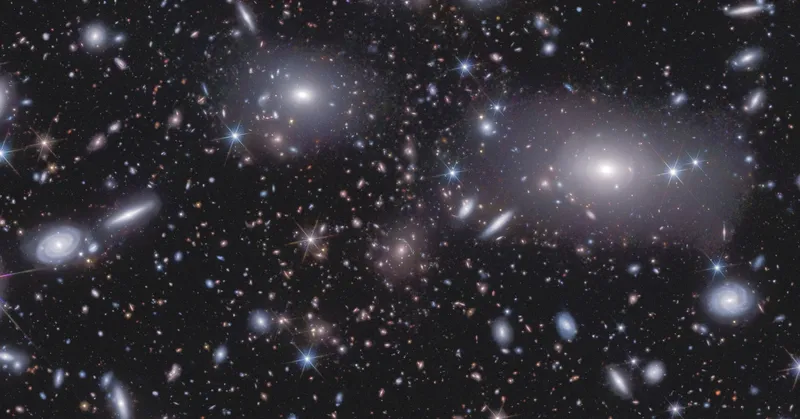
The European Space Agency’s Euclid mission released its first major data batch, capturing more than 900 million galaxies across a sky area equivalent to 9,500 full moons, laying the foundation for the largest three-dimensional map of the universe.
Story So Far
The European Space Agency’s Euclid space telescope has released its first major data batch, known as DR1-Foundation, covering about 13 months of observations and capturing light from more than a billion objects, including over 900 million galaxies.
The release covers 1,900 square degrees of sky—an area equivalent to roughly 9,500 full moons and about 14 percent of the total area the mission aims to survey over six years. It includes around 15,000 strong gravitational lensing candidates, more than 60 million quasar candidates, and spectra from over 160 million sources, totaling 1.7 petabytes of data.
Euclid, launched in mid-2023, is designed to map the large-scale structure of the universe to study dark matter and dark energy. Project scientist Valeria Pettorino called it a change in scale from earlier limited releases. The data will support studies of gravitational lenses, which act as natural scales for weighing galaxies including their dark matter content.
ESA’s announcement confirms the figures on galaxies, sky coverage, and data volume, with the agency stating the release lays the foundation for the largest-ever 3D cosmic map. Independent reporting from Reuters and other outlets corroborated the scale and contents. The full DR1 with higher-level products is scheduled for mid-2027.
This dataset advances understanding of the dark universe by providing an unprecedented catalog for mapping the cosmic web. Scientists expect it to yield new insights into galaxy formation and the accelerating expansion of the universe. The next major milestone is the complete DR1 release next year, which will include weak-lensing measurements. Public reaction on X described the scale as mind-bending.
People Sentiments Coverage tone — the tone of news coverage on this story: Positive
Discussion on X — and the discussion leans positive.
900 million galaxies is genuinely mind-bending.
— via X
The scale of this 3D map feels like looking into the infinite.
— via X
900 million galaxies is such a dizzying number it actually stops making sense in your head.
— via X
Keywords
Tags
Source
high interest in space community