

ESA Euclid telescope discovers most distant quasar yet, seen 630 million years after the Big Bang
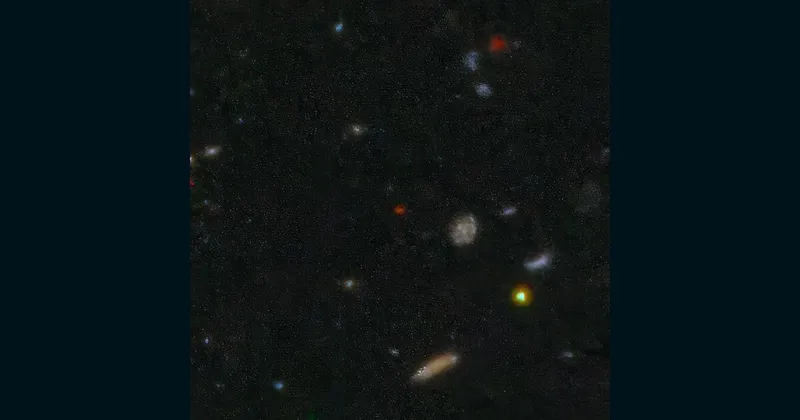
ESA’s Euclid space telescope has identified the most distant known quasar, J1504+6252 nicknamed Dún Aonghasa, powered by a 360-million-solar-mass black hole observed just 630 million years after the Big Bang, breaking the previous record by 40 million years.
Story So Far
What happened
The European Space Agency’s Euclid telescope has discovered the most distant quasar recorded so far, observed when the universe was only about 630 million years old.
Why it matters
The object, at redshift 8.13, challenges models of how supermassive black holes could grow so large so quickly after the Big Bang and extends the observable timeline of early galaxy formation by 40 million years.
What we know
Formally J1504+6252 and nicknamed Dún Aonghasa, it hosts a black hole of roughly 360 million solar masses; the discovery was confirmed with James Webb Space Telescope observations and published in Astronomy & Astrophysics.
What remains unclear
The precise mechanisms that allowed the black hole to reach this mass in such a short cosmic time.
What's next
Further Euclid survey data and follow-up observations may reveal more early quasars.
Our perspective
The record underscores both the power of wide-field space surveys and the remaining puzzles in early-universe black-hole growth.
How we know?
ESA, the Max Planck Institute for Astronomy, ABC News and Popular Science reported the discovery and the peer-reviewed paper on 24 November.
Original reporting
Independent corroboration
People Sentiments
Discussion on X — and the discussion leans positive.
BREAKING: Scientists have discovered the most distant quasar ever observed, powered by a supermassive black hole that existed just 630 million years after the Big Bang.
— via X
Euclid finds the most distant quasar known, seen 630 million years after the Big Bang.
— via X
Keywords
Tags
- Science
- Astronomy
- ESA
- Euclid
- Cosmology