

Chinese scientists chill atoms to 9.7 picokelvin aboard space station, a record cold
Researchers aboard China's Tiangong space station cooled a cloud of rubidium atoms to an equivalent temperature of 9.7 picokelvin, the lowest reported for such a system, and watched it expand for seven seconds.
Story So Far
Chinese scientists have cooled a cloud of atoms aboard the country's space station to 9.7 picokelvin, the lowest equivalent temperature ever reported for such a system, in an experiment that used weightlessness to watch the atoms drift for seven seconds. The work was published in the journal Science on November 5.
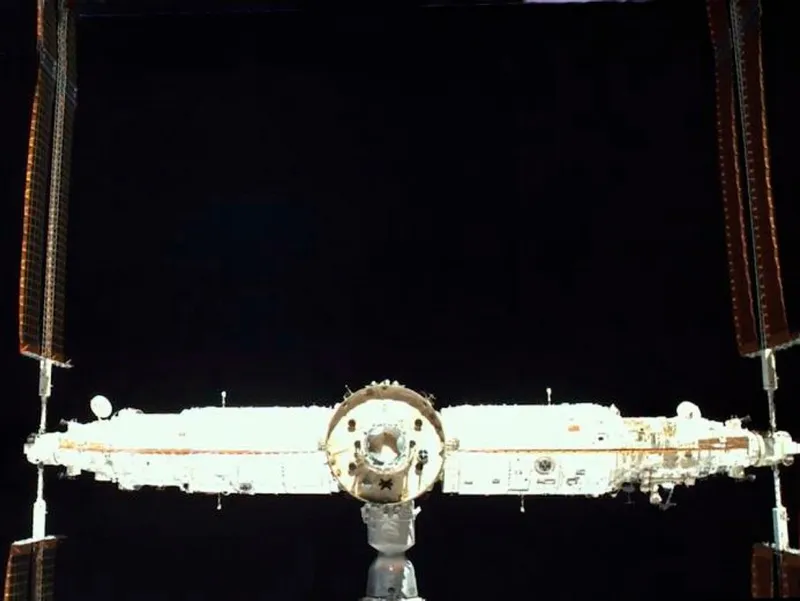
The team, from Peking University, the Shanghai Institute of Optics and Fine Mechanics and the Chinese Academy of Sciences, created a Bose-Einstein condensate of about 20,000 rubidium-87 atoms in the Cold Atom Physics Rack of the station's Mengtian laboratory module. The condensate was held in an optical dipole trap, released, and its expansion tracked for 7.0 seconds. The equivalent temperature came out at 9.7 picokelvin, with an uncertainty of plus 3.2 and minus 2.7 picokelvin.
The previous lowest figure for such a system was 38 picokelvin, reached in a drop tower in Bremen in 2021, and NASA's Cold Atom Lab aboard the International Space Station had reached 52 picokelvin. The rack flew with the Mengtian module in October 2022, after feasibility work that began in 2011. Microgravity matters because it weakens the forces holding the atoms and lets researchers follow the cloud for longer than a laboratory on the ground allows.
The 9.7 picokelvin figure is an equivalent temperature, worked out from how slowly the released cloud expands, not a reading from a thermometer, and the paper's abstract confirms the atom count, the temperature and the seven-second expansion time. The equipment and the station itself were nowhere near that cold. The Chinese Academy of Sciences describes the result as the coldest matter created by humans; that is the agency's characterisation of the record against earlier equivalent-temperature measurements. The result comes from a single facility and has not yet been reproduced independently.
The authors say the record could open a new generation of optical-trap experiments in quantum simulation and precision measurement in space. Uses such as tests of the equivalence principle and more precise gravity measurements were discussed in the paper as possibilities for the apparatus, not as results already demonstrated.
The next test for the result is independent replication, and the team is expected to use the rack for further experiments in orbit. The station flies about 400 kilometres above Earth, and the rack has operated since its launch in October 2022.
Keywords
Tags
Source
Coldest matter ever measured, made in orbit