

AMD and Intel, move over: AI designed an all-new CPU — and claims it is 4.6x more efficient
US startup Architect Labs says its AI systems designed a general-purpose CPU, Frostbite, from scratch, reporting 4.59 times the performance per watt of a conventional core across 25 workloads in pre-silicon simulation — but no chip has been manufactured and the result has not been independently verified.
Story So Far
What happened
Architect Labs, a US AI startup, says its AI systems have designed a complete general-purpose CPU from scratch. The chip, called Frostbite, has a new instruction set built around interaction nets, a model of computation in which a program is a graph of nodes and work proceeds by rewriting pairs of connected nodes. The company says its systems worked through the compiler, instruction set, architecture, microarchitecture, register-transfer-level design, verification and final chip layout, and reports a 4.59-fold advantage in performance per watt over a conventional CPU core across 25 workloads.
Why it matters
Single-core CPU performance has largely stalled since the early 2000s, and the industry has leaned on adding cores instead. Frostbite takes a different route: by keeping every value owned by exactly one part of the program and doing away with shared mutable state, it aims to cut the area and power spent on caches, coherence and instruction decoding. If the numbers survive contact with real silicon, the result would suggest AI systems can open up chip-design space that human teams have not explored.
What we know
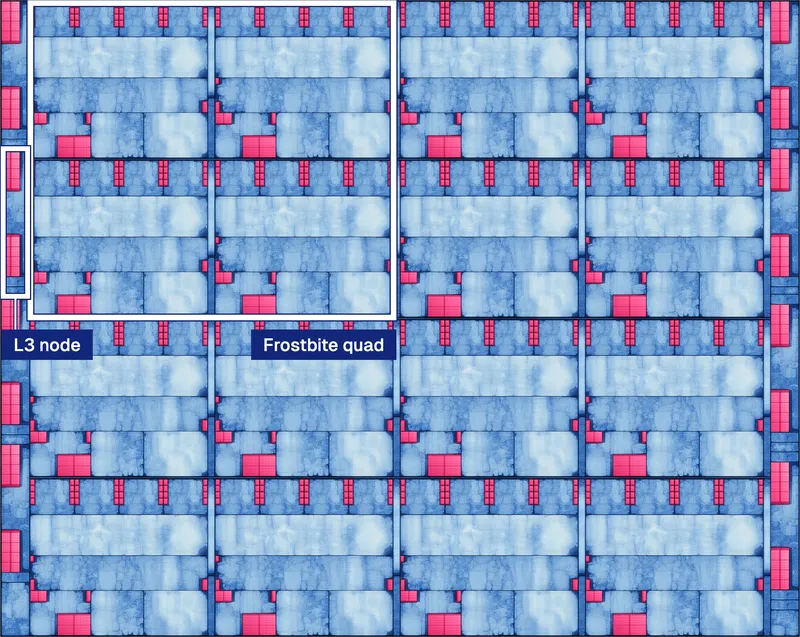
Frostbite was synthesized on a 7 nm process, reaching 800 MHz at synthesis and 500 MHz in its final layout. One Frostbite quad — four computing tiles in a two-by-two grid, paired with four L3 nodes — covers 0.792 square millimetres, against 0.895 for the reference core. Across all 25 workloads the company reports a geometric mean of 4.59 times the reference core's performance per watt and 8.77 times its performance per unit of area. The split is 6.02 times on the 10 workloads used to tune the design and 3.83 times on the 15 workloads held back until the final evaluation. The design cuts the energy spent on memory to 38 percent and on fetching, decoding and issuing instructions to 6 percent, against 57 and 27 percent for the reference core.
What remains unclear
The reference processor has not been named — the company says it cannot disclose it for legal reasons — so the headline comparison cannot be checked against a known part. It is a dual-issue, in-order core, a narrower target than the wide out-of-order designs in flagship processors, and the workloads are small kernels rather than industry-standard suites. No Frostbite chip has been manufactured, no RTL or instruction-set documentation has been released, and no outside party has replicated the result.
What's next
Architect Labs says it will test larger Frostbite configurations against multicore CPUs using industry-standard SPEC and PARSEC benchmarks, build an FPGA-hosted playground where anyone can run a program on the design, develop a preliminary operating system, and release the RTL and instruction set.
How we know?
Architect Labs set out the design, the method and the numbers in a long technical post on its own site, and Notebookcheck reported the announcement with the same figures and the same caveats. The performance numbers come from synthesis and layout, not from a manufactured chip, and the company is open about that.
Original reporting
Independent corroboration
Verification notes
- Confirmed: Architect Labs' announcement states the 4.59x performance-per-watt geometric mean across 25 workloads, the 6.02x search-set and 3.83x held-out splits, the 8.77x performance-per-area figure, the 7 nm synthesis at 800 MHz and 500 MHz final layout, and the quad and reference-core areas — all repeated in Notebookcheck's report.
- Reported: The performance figures are the company's own, from pre-silicon simulation and layout; the comparison core is unnamed, so the baseline cannot be independently checked.
- Not independently substantiated: No independent party has replicated the result, tested silicon, or reviewed the RTL, which has not been released.
Announcement covered by Notebookcheck, MarkTechPost and independent technical analysis within days; an unusual AI-hardware claim drawing close scrutiny.
Keywords
Tags
- Technology
- AI
- semiconductors
- CPU design
- Architect Labs