

Airborne organic nitrogen feeds the oceans far more than thought, study finds
A study in Science finds about 12.8 million tonnes of organic nitrogen fall from the atmosphere into the oceans each year, about 27% of all nitrogen deposited from the air.
Story So Far
What happened
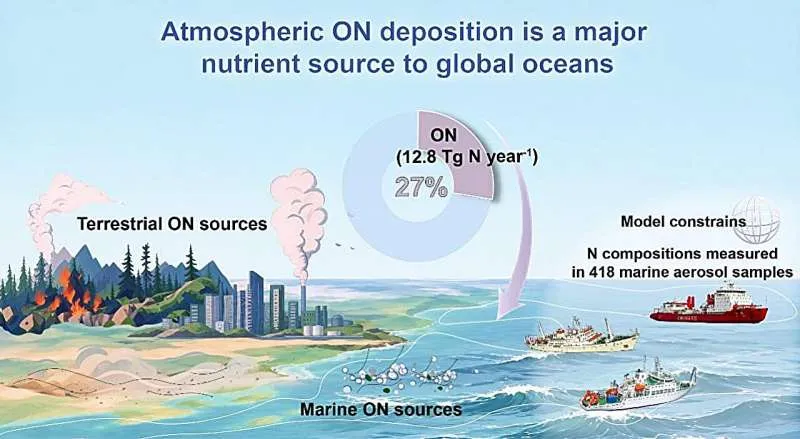
About 12.8 million tonnes of organic nitrogen fall from the atmosphere into the world's oceans each year, roughly 27% of all nitrogen deposited from the air, according to a study published in the journal Science on 19 November. The work, co-led by researchers at the Hong Kong University of Science and Technology and the Southern University of Science and Technology, measured 418 marine aerosol samples from 21 research cruises, including expeditions to the Arctic and Antarctic.
Why it matters
Nitrogen is a key nutrient for marine life, but the organic share of what falls from the air had been poorly measured because of its chemical complexity, leaving a gap in understanding of the global nitrogen cycle. The findings reshape how scientists link air pollution and wildfires to ocean productivity, and the researchers say changes in these emissions may affect marine nutrient dynamics.
What we know
In nitrogen-limited waters such as the central Atlantic and the Indonesian seas, organic nitrogen accounts for about half of deposited nitrogen, and on average it made up 30% of the nitrogen in the aerosols sampled. The largest sources were biomass burning at 4.8 million tonnes a year, marine aerosol emissions at 3.9 million tonnes, and imines formed chemically in the atmosphere at 2.2 million tonnes. Land-based sources, including wildfires and human activities, supply about 70% of the total.
What remains unclear
The 12.8 million tonne figure is a model estimate constrained by the shipboard samples, not deposition measured directly at sea, and it carries a wide uncertainty range, from 4.0 to 22.7 million tonnes, with the share of total deposition possibly anywhere from 11% to 40%.
What's next
The research team is working to integrate the findings into global circulation models to improve predictions of future ocean productivity and its impact on the carbon cycle.
How we know?
The Hong Kong University of Science and Technology announced the study on 20 November, the paper is published in Science, and the figures were corroborated by independent coverage. The central estimate is model output, and its wide uncertainty range comes from the paper's abstract.
Original reporting
Independent corroboration
Verification notes
- Confirmed: the study was published in Science on 19 November, co-led by HKUST and SUSTech, based on 418 marine aerosol samples from 21 cruises.
- Reported: the 12.8 million tonne annual deposition figure and the 27% share, as a model estimate with a stated uncertainty range.
Keywords
Tags
- science
- oceans
- nitrogen
- HKUST
- climate