
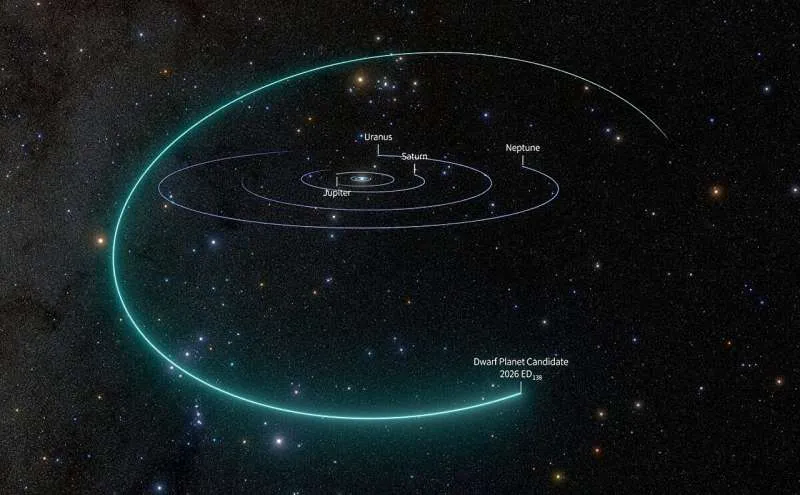
The Vera C. Rubin Observatory has revealed its first dwarf planet candidate, 2026 ED138, a large icy body orbiting beyond Pluto that could become the sixth recognised dwarf planet if follow-up observations confirm its size and shape.
The NSF-DOE Vera C. Rubin Observatory has spotted its first dwarf planet candidate, a large, bright trans-Neptunian object provisionally designated 2026 ED138, the observatory announced on 27 October. The observations were announced by the International Astronomical Union Minor Planet Center, and the results were presented at a press conference at the American Astronomical Society's Division for Planetary Sciences meeting in Spokane, Washington.
ED138 orbits the Sun beyond Pluto, currently at a distance of about 46 astronomical units, where one astronomical unit is the average distance between Earth and the Sun, compared with Pluto's average of about 40. Its orbit is tilted almost 25 degrees off the plane of the solar system, classifying it as a hot-classical trans-Neptunian object, a tilt the team suggests came from gravitational interactions with Neptune. Based on its distance, brightness and estimated surface reflectivity, the team estimates its size at between 600 and 1,500 kilometres, roughly 1,000 kilometres across according to University of Washington astronomer Mario Juric, who called it the largest trans-Neptunian object found in about 20 years.
The candidate was found by Rubin operations team member Matthew Holman of the Center for Astrophysics
Harvard & Smithsonian, who on the evening of 13 October ran Rubin data collected earlier in 2026 through a search code he developed with colleague Kevin Napier. Juric then found 20 more Rubin observations going back to 4 March 2026, for 30 observations on 20 nights between March and July, and archival images from the Dark Energy Camera going back to 2016 allowed the team to trace more than 10 years of its orbit. ED138 was found in a crowded region close to the plane of the Milky Way, where millions of background stars had hidden it from most telescopes.
The observatory's release confirms the designation, the Minor Planet Center announcement, the 46-astronomical-unit distance, the 25-degree tilt and the 600-to-1,500-kilometre size range, while the University of Washington and phys.org coverage corroborate Holman's and Juric's roles and the roughly 1,000-kilometre estimate. The candidate status is explicit throughout: ED138 is not yet a confirmed dwarf planet, and its size is an estimate from brightness and reflectivity rather than a measured diameter. Infrared observations are still needed to constrain its exact size and confirm its nature.
If confirmed, ED138 would join the five dwarf planets recognised by the International Astronomical Union: Pluto, Ceres, Eris, Haumea and Makemake. To qualify, an object must be massive enough for its own gravity to pull it into a round shape, and icy bodies as large as ED138 is estimated to be are expected to be round. Holman said that if confirmed as a dwarf planet, ED138 would join a very small family of worlds, and that Rubin imaging the whole southern sky again and again for 10 years means any others hiding in places earlier surveys skipped are now within reach.
The discovery also shows what Rubin can do before its main survey is fully under way. The Legacy Survey of Space and Time began in June 2026, and in April the Rubin solar system team had already submitted observations of more than 11,000 new asteroids, including roughly 380 trans-Neptunian objects, to the Minor Planet Center. Scientists around the world can now organise follow-up observations to pin down ED138's size, composition and orbit, and those observations will decide whether it becomes the solar system's sixth recognised dwarf planet.