
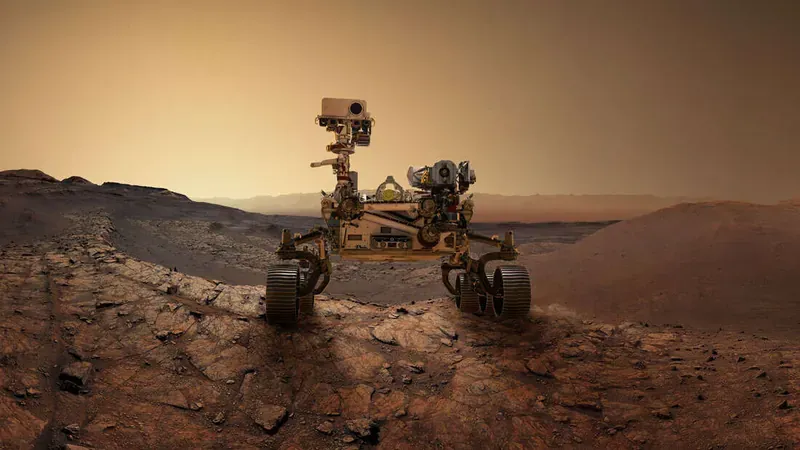
NASA's Perseverance rover has detected the finest dust particles yet found on Mars, as small as around 100 nanometres, a finding that matters for the design of suits and habitats for future crewed missions.
NASA's Perseverance rover, operating in and around Jezero Crater in Mars' northern hemisphere since landing in 2021, has detected the finest particles of dust yet found on the planet. It documented ultrafine particles as small as around 100 nanometres wide, about 500 times thinner than a human hair, alongside a category of fine particles of less than 2.5 micrometres in diameter, or 30 times thinner than a strand of hair. Previous measurements had resolved Martian dust particles only down to about 3 micrometres.
Perseverance measured dust particles that stuck to rover hardware, including samples of possible spacesuit materials carried aboard the six-wheeled vehicle to observe how they hold up in the planet's harsh environment. The samples included the manufactured fibre Vectran and the protective coating Teflon, each about three-quarters of an inch square. Vectran appeared to hold larger dust particles, with the greatest prevalence on the underside of its weave, while the Teflon sample held less dust but the dust it held was finer, reflecting differences in how electrostatic properties attract particles of different sizes to each material.
The finding matters because smaller particles have a higher potential to penetrate deeper into the human body and are harder for the body to clear, and particles that small could reach an astronaut's lungs, enter the bloodstream and potentially damage vital organs. Martian dust contains silica, iron compounds and chlorine compounds such as perchlorate, which are known to be harmful at high enough doses on Earth, although toxicity depends on dose and duration. NASA is looking to send astronauts to Mars as early as the 2030s, and the results will inform the choice of suit and habitat materials and cleaning methods that work at sub-micron particle sizes.
The measurements come from Perseverance's Planetary Instrument for X-ray Lithochemistry, and the findings are described in a study in the Proceedings of the National Academy of Sciences led by planetary scientist Scott VanBommel of Washington University in St. Louis, a member of the Perseverance science team. VanBommel said there is no evidence that the dust damaged the spacesuit materials, only that the materials interacted with dust differently, and he stressed that the results do not mean Mars is too dangerous for humans. Mars dust is a hazard to be designed for, in the same way radiation and distance are, and it differs from lunar dust, whose sharp, angular particles come from impacts rather than wind weathering.
The comparison with the Moon is instructive: dust from the Apollo landings of 1969 to 1972 degraded outer spacesuit layers, damaged seals and scratched visors, and may have been associated with hay-fever-like symptoms in some astronauts. For Mars, chemistry and particle size are the primary concerns rather than shape. NASA is studying suitports, docking stations for spacesuits, and dual-chamber airlocks to keep dust out of living areas, and how much dust reaches a habitat will depend largely on how suits and airlocks are designed, work that is still under way.