
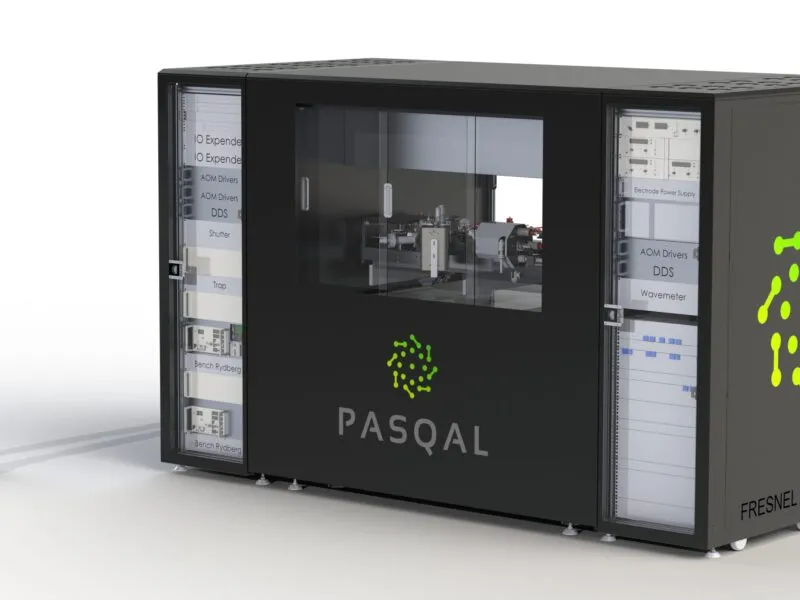
Pasqal said its 256-qubit neutral-atom processor revealed an unexpected slowdown in a two-dimensional quantum magnet after a sudden disturbance, in a regime where three classical simulation methods no longer agree, in a preprint with the Flatiron Institute and four European institutions.
Pasqal announced on October 27 that its 256-qubit neutral-atom processor has revealed an unexpected behaviour in a two-dimensional quantum magnet. Under certain conditions, the system took far longer to settle after being abruptly disturbed than theory predicts, a result released as a preprint with the Flatiron Institute, the University of Augsburg, Forschungszentrum Julich, the University of Regensburg and the Institut d'Optique-CNRS.
The experiment watched a 16 by 16 grid of atoms relax after a sudden change, known as a quench. Depending on the strength of the applied field, the system settled in three different ways. Two were expected. The third was not: an abrupt slowdown that the team says plainly it cannot yet explain. Under a strong enough field, the magnet also began to behave like a fundamentally different kind of magnet, known as an XY-like magnet, which is studied for how magnetic information travels.
The result matters because it appears exactly where classical computation runs out of road. Three state-of-the-art classical simulation methods were run alongside the experiment, and all three tracked the processor at first, then peeled away from the measurement and from each other as the complexity inside the system outgrew what they could represent. Beyond that point, none of them could reliably describe what happened next.
The findings are published as a preprint, not yet as a peer-reviewed paper, and Pasqal itself states that they do not constitute a demonstrated computational quantum advantage. The team checked that the behaviour was genuine physics rather than a machine artefact by modelling the device's noise and cross-checking against exact calculations where those remain reliable, and the earlier work with the same processor, which reproduced a real magnetic crystal, provides the benchmark for that claim.
If the unexplained slowdown holds up under further study, it would show quantum processors being used not only to reproduce what physicists already know but to reveal behaviour they did not anticipate. The next step is for other groups to test the preprint's claims, and for the team to explain the third settling regime it has so far only observed.