
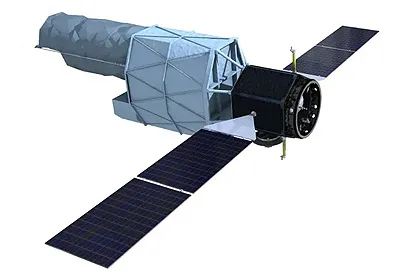
NASA confirmed its UVEX ultraviolet space telescope after it passed the Key Decision Point C review, committing to a launch by January 2031 and a total lifecycle cost of $590 million for an all-sky ultraviolet survey.
NASA has confirmed its UVEX space telescope after the mission completed a technical and programmatic review known as Key Decision Point C. With that milestone passed, the agency has committed to a launch by January 2031 and a total lifecycle cost of $590 million.
UVEX, short for UltraViolet EXplorer, was selected for development in 2024 as a Medium-Class Explorer mission. It will conduct a sensitive survey of ultraviolet light across the entire sky, offering new insight into how galaxies and stars evolve, and it will be able to point quickly at sources of ultraviolet light to capture the explosions that follow bursts of gravitational waves from merging neutron stars.
The mission's principal investigator is Fiona Harrison at Caltech in Pasadena, California. Other institutions involved include the University of California at Berkeley, NASA's Jet Propulsion Laboratory, Northrop Grumman and Space Dynamics Laboratory.
The confirmation, cost and launch commitment all come from NASA's own announcement on October 27, which is the primary source for this story, and the mission overview published by the project team is consistent with it on the telescope's design, a 75 cm three-mirror telescope feeding two imagers and a spectrograph.
Together with other wide surveys, including the Nancy Grace Roman Space Telescope, UVEX is intended to help build a modern map of the universe across different wavelengths of light. The next milestones will be in hardware and testing over the years before launch, and the January 2031 date is the commitment NASA has now formally made.