
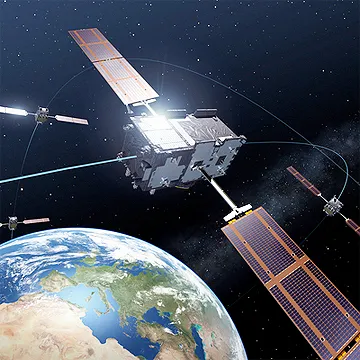
The European Space Agency extended contracts with Thales Alenia Space and Airbus Defence and Space for four more Galileo Second Generation satellites, scheduled for delivery in 2031, taking the contracted fleet from 12 to 16.
The European Space Agency has extended contracts to build four additional Galileo Second Generation satellites, taking the contracted fleet to 16, the agency announced on October 27. Two satellites each go to Thales Alenia Space of Italy and Airbus Defence and Space of Germany, which have each been under contract since 2021 to build six second-generation satellites.
The Thales extension was signed on October 23 in Rome and the Airbus extension on October 26 in Ottobrunn, Germany. The four additional satellites are scheduled for delivery in 2031 and launch right after, and will be identical to those already under development. ESA extended the contracts on behalf of the EU Agency for the Space Programme, the satellite navigation system's service provider, for the European Union as Galileo's owner.
The second-generation satellites carry fully digital navigation payloads, a better-performing navigation antenna, inter-satellite links and an advanced atomic clock configuration, which ESA says will provide more robust navigation services. Laurent Jaffart, ESA's director of resilience, navigation and connectivity, said the contracts safeguard the continuity of Europe's satellite navigation services, respond to evolving user needs and strengthen Europe's strategic autonomy.
The core facts are confirmed in the European Commission summary of the ESA releases and independently in trade reporting of the same 12-to-16 expansion and two-plus-two split. What is not disclosed is the financial value of the additions: neither ESA nor the contractors gave a figure, and this story does not invent one. A first second-generation launch date of 2028 appears only in secondary trade reporting and is left out, since it is not in the ESA summary.
The stakes are continuity. Galileo is Europe's independent alternative to the US GPS system, and a gap in the second-generation fleet would leave that independence thinner just as satellite navigation underpins transport, finance, agriculture and emergency services. Delivery in 2031 means the new satellites are a long-term bet, not a near-term fix, and their value will be judged by whether the digital payloads and inter-satellite links deliver the more robust service ESA promises.