
Simulations from Georgia Tech suggest asteroid 1998 KY26 is too warm to hold ice, casting doubt on the idea that it is a 'dark comet' ahead of Hayabusa2's 2031 visit.
A tiny asteroid that astronomers once suspected of being a 'dark comet' is probably nothing of the sort, according to new simulations that show it is far too warm to hold the ice such a comet would need. The asteroid, 1998 KY26, is just 11 metres across and one of the fastest-spinning rocks known, turning once in under five and a half minutes — yet it accelerates in a way that has puzzled astronomers, as if something were pushing it.
Researchers Korbin Hansen and Masatoshi Hirabayashi, at the Georgia Institute of Technology, ran 13 simulations of the asteroid's surface and interior to test whether ice could survive inside it and vent gas, the way a comet does, without any visible cloud. In every run, the answer was no: for ice to last over long periods, temperatures would have to stay below about minus 128 degrees Celsius, and 1998 KY26 is far warmer than that. The likelier explanation for its strange acceleration, they argue, is sunlight and heat radiation pushing on its surface.
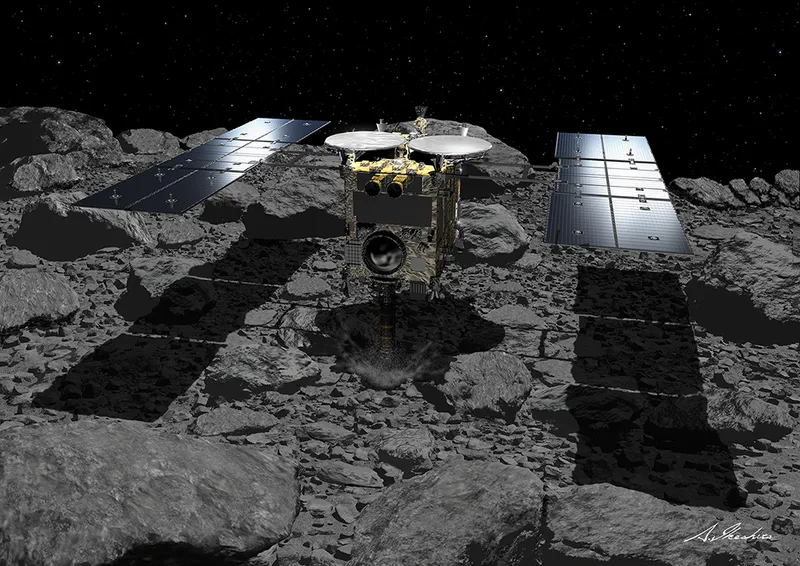
The question matters because Japan's Hayabusa2 spacecraft is due to arrive at 1998 KY26 in 2031, and what it finds will settle the argument. The asteroid was chosen as the mission's extended target precisely because its acceleration was unexplained; if it turns out to be a dark comet after all, it would be a new class of object, and if it is not, the mission will still return the first close look at one of the smallest and fastest-spinning asteroids ever visited.
The findings are published in Icarus, a peer-reviewed journal, and the simulations are the authors' own: 13 runs, all pointing the same way, with the minus 128 degree threshold as the key number. But simulations are not a measurement — the asteroid's true nature can only be confirmed when Hayabusa2 arrives in 2031, and the paper presents its conclusion as making a dark-comet explanation highly unlikely, not impossible. The 'dark comet' label itself was always a hypothesis for the unexplained acceleration, not an established classification.
Small asteroids like 1998 KY26 are the hardest to understand and the most numerous, and how they move matters for tracing the solar system's history — and, at the margins, for predicting where rocks go. Hayabusa2's visit will test the simulation directly, and either answer would be useful: a confirmed dark comet would open a new category, while a radiation-driven explanation would sharpen the models used to track thousands of similar objects.