
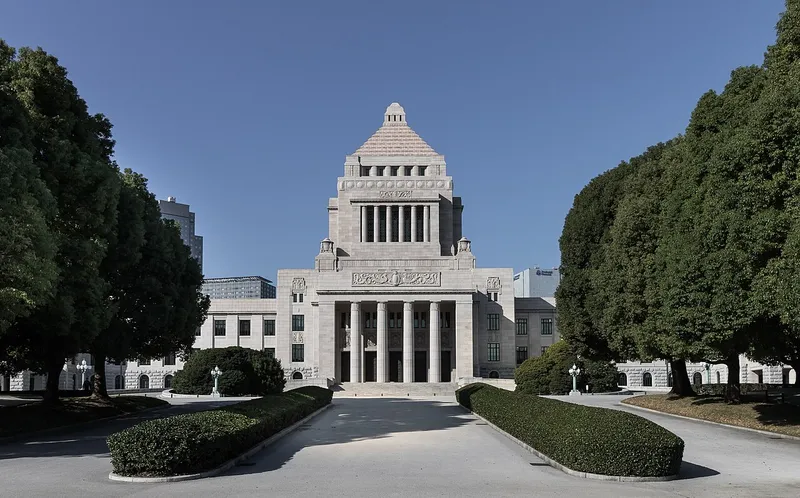
Japan's government is considering explicitly stating an emergency exception to its long-standing non-nuclear principles in its revised National Security Strategy, a move that would allow nuclear weapons to be brought into the country in a crisis and sharpen the credibility of US nuclear deterrence.
Japan's government is considering writing an explicit exception into its long-standing non-nuclear principles, a step that would formally allow nuclear weapons to be brought into the country in an emergency for the first time.
The option under discussion is to state the exception in the revised National Security Strategy, due to be updated along with related defence documents by the end of the year. One formulation being weighed would permit the introduction of nuclear weapons in a contingency, reflecting a position first outlined by then Foreign Minister Katsuya Okada in parliament in March 2010 and endorsed by successive governments, including that of Prime Minister Sanae Takaichi.
The three principles — not possessing, not producing and not permitting the introduction of nuclear weapons — have been a pillar of Japanese policy since Prime Minister Eisaku Sato declared them in 1967, and were adopted by the Diet in 1971. The current National Security Strategy, adopted in 2022, pledged to uphold them. The government is expected to stop short of revising the principles themselves, instead stating the exception alongside them.
The reporting rests on a single source familiar with the matter, cited by Kyodo News, and no government official has confirmed the plan on the record — so the proposal should be read as under active consideration rather than decided. What is firmly on the record is the history around it: Okada's 2010 parliamentary remarks, Takaichi's earlier doubts about the non-introduction principle before she became prime minister, her statement after taking office that she shared Okada's view, and her more recent comment that there was "room for consideration" on how the security documents address US extended deterrence. Foreign Minister Toshimitsu Motegi said in October that the government needed to consider how other countries might perceive the move.
The aim, as described in the reporting, is to make US nuclear deterrence protecting Japan more credible. Takaichi has argued that the ban on nuclear weapons entering Japan could complicate port calls by nuclear-armed US vessels and weaken that deterrent in a crisis — a tension that has shadowed the principles since the 1960 US-Japan Security Treaty.
Putting the exception in an official strategy document would carry more weight than remarks in parliament, and it would land in a country where the principles are bound up with the memory of Hiroshima and Nagasaki. The survivors' organisation Nihon Hidankyo, which won the Nobel Peace Prize, has already warned that revisiting them would contradict survivors' expectations. Whether the government proceeds, and in what wording, will be settled when the revised strategy is published before the year is out.
People Sentiments Public Mood: Neutral
- Prime Minister Sanae Takaichi has previously questioned whether the ban on nuclear weapons entering Japan is realistic, given reliance on US extended deterrence
- Foreign Minister Toshimitsu Motegi cautioned in October that the government needed to weigh how other countries might perceive such wording
- Atomic bomb survivors' group Nihon Hidankyo reacted negatively last year to any revisiting of the principles, calling it contrary to survivors' expectations