
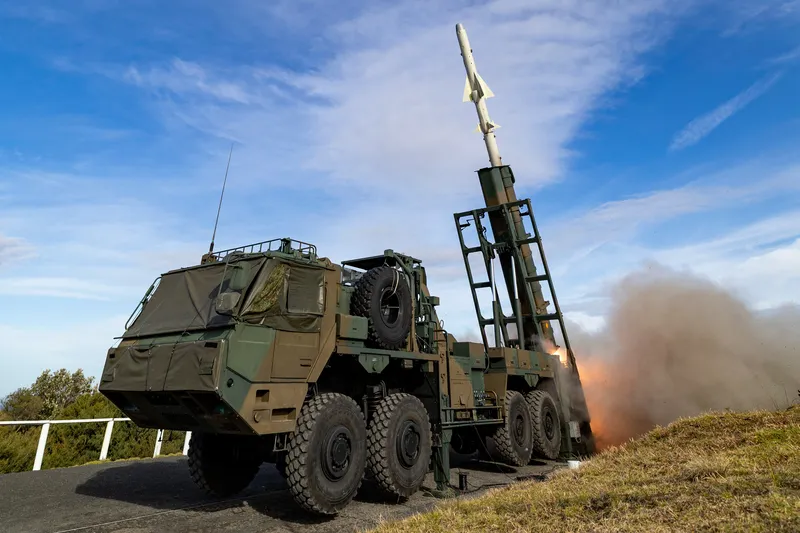
Japan has sent personnel to India to coordinate on training for its Ground Self-Defense Force's long-range surface-to-ship missiles and small attack drones, its top ground officer confirmed in Tokyo.
Japan has dispatched personnel to India to coordinate on defence matters as it explores training options for the Ground Self-Defense Force's long-range surface-to-ship missiles and small attack drones, the force's chief of staff confirmed on Tuesday.
General Masayoshi Arai told a press conference in Tokyo that developing training that makes full use of a missile with a roughly 1,000-kilometre range was a major challenge. He said Japan was considering training environments at home and abroad, and, when asked whether the deployment to India also involved exploring launch sites for small attack drones, said that it included such possibilities and that various firing options were being adjusted. He declined to give further details, citing Japan's relationship with India.
The move follows a 34-member Ground Self-Defense Force delegation visit to India earlier in October, which included interactions with the Indian Army and the Defence Research and Development Organisation. The Type 25 surface-to-ship missile at the centre of the training question is the upgraded successor to the Type 12, with a reported range of about 1,000 kilometres against roughly 200 kilometres for the original, and it was first deployed at Camp Kengun in Kumamoto in March.
Arai's confirmation is reported by IANS and is corroborated on the substance by reporting that cites Japan's NHK and The Japan Times, which say officials arrived in India earlier in October and inspected several sites for about a week. One detail differs between accounts: the delegation's dates are given as October 6 to 9 in one report and October 4 to 9 in the Indian Army's own post, so this story dates the visit only to earlier in October. The missile's range and its role as a counterstrike weapon are also consistent across the GSDF's own exercise reporting and specialist coverage of its first public drill at Onohara on October 25.
The significance lies in range. A weapon that can reach 1,000 kilometres cannot be exercised at full stretch inside Japan's crowded training areas, which is why Tokyo has also been working on access to Australian ranges and why India, with its larger ranges and a deepening defence relationship, is now part of the same search. Arai has described Japan's security environment as its most severe and complex since the Second World War.
What happens next depends on the coordination now under way. No agreement on Indian ranges has been announced, and Arai's refusal to give details suggests the discussions are at an early stage. The nearer milestone is the end of the Keen Sword exercise on October 29, where the Type 25 has already made its first training deployment outside its home base.