
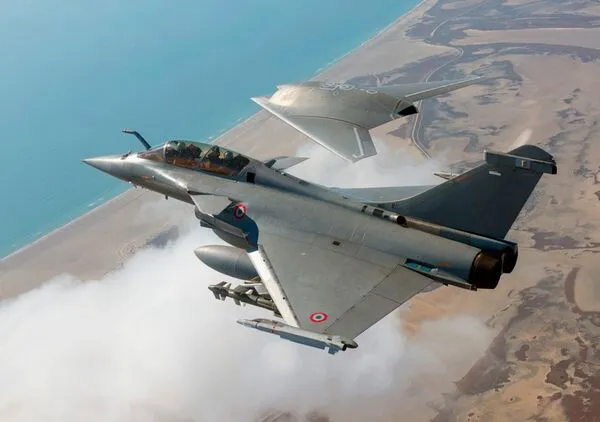
France is working with 10 European countries on a forward deterrence initiative that could include temporary deployments of nuclear-capable Rafale jets, expanded intelligence sharing and early-warning links, The Wall Street Journal reported on October 26, with France retaining sole control of its nuclear weapons.
France is working with 10 European countries on a forward deterrence initiative that could include temporary deployments of nuclear-capable Rafale fighter jets, expanded intelligence sharing, early-warning systems and strategic communications, The Wall Street Journal reported on October 26. The countries involved, alongside France, are the United Kingdom, Germany, Poland, the Netherlands, Belgium, Greece, Finland, Norway, Sweden and Denmark.
France would retain sole authority over its nuclear weapons under the plan. There is no nuclear-sharing arrangement giving partner countries control over the French arsenal, and the French president alone would decide on any use. Cooperation varies by country and could cover joint military exercises, intelligence exchanges and discussions on nuclear deterrence, rather than every partner hosting French aircraft.
France has pursued the framework through bilateral discussions and separate steering groups with each partner, a hub-and-spokes model that keeps Paris at the centre rather than placing its nuclear force under a shared European command. Finland became the 10th participating country on September 14, 2026. Italy has declined to join, and the three Baltic states are not part of the current group.
The Journal's account is reproduced consistently by three outlets, which agree on the 10-country list, the Rafale element and France's retained control. No French government statement confirming the framework was available in the sources used, so the initiative is reported here as a reported plan, not as an official announcement, and the extent of any future Rafale deployments remains unspecified.
The initiative, which President Emmanuel Macron outlined in the spring, comes as European governments reconsider how far they can rely on Washington to deter Russia. Macron said in March that France would restart nuclear-device production after a decades-long pause and cease publishing the size of its stockpile. The plan's logic is ambiguity: a potential adversary would face uncertainty over whether French jets deployed in a crisis were carrying nuclear weapons.
The stakes are about credibility as much as capability. If European partners deepen exercises and intelligence links with France, the continent gains a second, European-owned layer of deterrence alongside American nuclear weapons stationed in Europe under NATO sharing arrangements. If the initiative stalls at discussion, it will have signalled intent without changing the military balance. The next test is whether any partner publicly confirms a Rafale deployment or a joint exercise under the framework.