
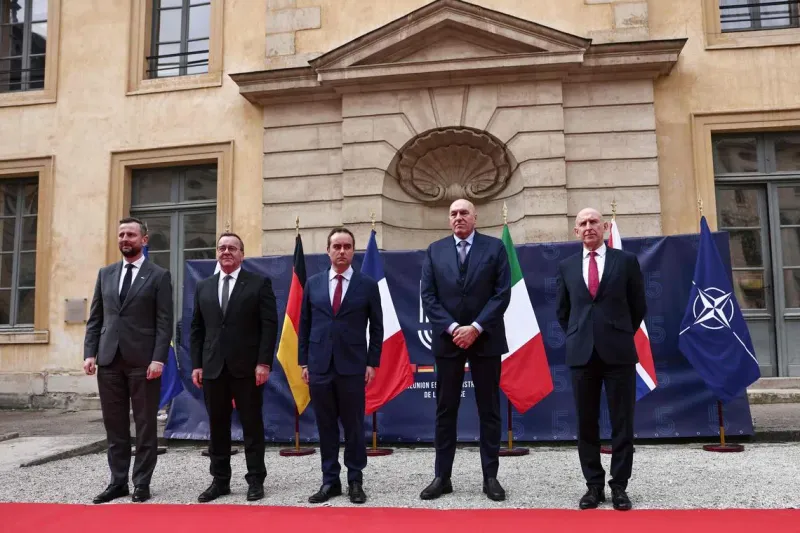
The defence ministers of France, Germany, Italy, Poland and the United Kingdom met in Paris on Monday as the Group of Five and pledged that Europe must assume greater political and military leadership within NATO while continuing support for Ukraine.
The defence ministers of France, Germany, Italy, Poland and the United Kingdom met in Paris on Monday as the Group of Five, known as the E5, and issued a joint statement pledging that Europe must assume greater political and military leadership within NATO.
The statement calls Russia “the most acute and long-term threat to Euro-Atlantic security and stability,” citing Russia's war against Ukraine, violations of Allied airspace, sabotage and growing multi-domain hybrid attacks. It says Europe must modernise its forces and deepen defence-industrial cooperation on common and standardised requirements.
That leadership, the ministers said, must be exercised in close coordination with the United States and other Allies, and continued United States engagement remains essential. The statement reaffirms support for Ukraine by all available means, politically, militarily and financially, and continued action against Russia's shadow fleet in accordance with international law. It adds that the Coalition of the Willing will contribute to robust security guarantees once a ceasefire or peace agreement is in place.
The positions above are taken from the joint statement itself, published by the UK government. Individual ministers are not named in this report because the primary text retrieved does not verify a name list, and casualty claims from separate battlefield reporting are not attributed to the statement.
The statement is aimed in two directions at once: at Moscow, as a declaration that Europe's largest defence powers intend to carry more of the continent's security burden, and at Washington, as an assurance that greater European leadership will be exercised inside the alliance rather than apart from it.
The test of the statement will be delivery rather than language. Modernised forces, common requirements and deeper industrial cooperation are programmes that take budgets and contracts, and the guarantees promised for a future ceasefire will only matter if the coalition behind them is still assembled when a ceasefire arrives.