
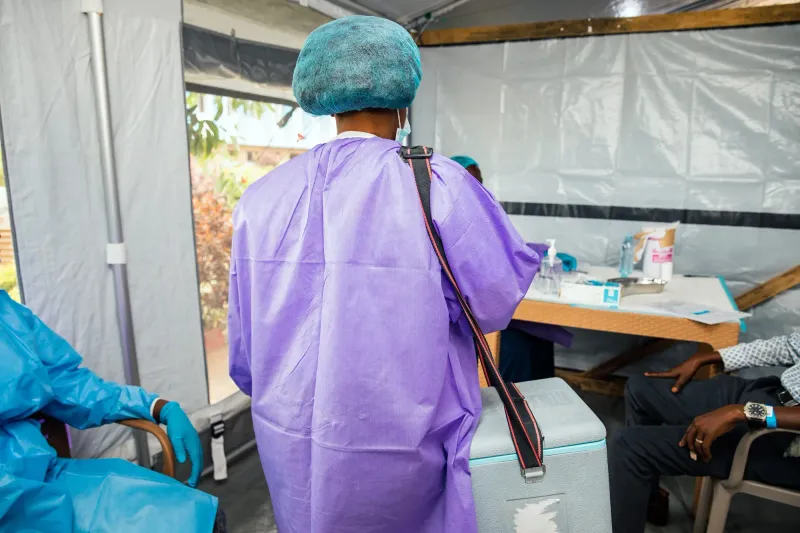
The World Health Organization has recommended two vaccines designed specifically against the Bundibugyo Ebola strain — Oxford's ChAdOx1 and Moderna's mRNA-1469 — join the Tumaini trial in DR Congo, the first time Bundibugyo-specific vaccines will be tested during an outbreak. The trial, launched in Bunia on 23 October, is testing vaccines against a strain with no approved vaccine, amid more than 10,500 cases and 5,126 deaths.
Two experimental vaccines designed specifically against the Bundibugyo strain of Ebola will join the clinical trial under way in the Democratic Republic of Congo, the World Health Organization has announced, in the first test of Bundibugyo-specific vaccines during an outbreak of the disease.
The candidates are ChAdOx1, developed by the University of Oxford with the Serum Institute of India, and mRNA-1469, developed by Moderna. They will enter the Tumaini trial once national approvals are granted, after WHO's independent Technical Advisory Group on Candidate Vaccines Prioritization recommended both for further clinical evaluation on the basis of preclinical and early clinical evidence.
Tumaini, Swahili for hope, was launched on 23 October in Bunia, capital of Ituri province and the epicentre of the outbreak, and is led by the Congolese Institut National de Recherche Biomédicale. It uses ring vaccination, offering vaccine to contacts of confirmed cases, and is built to test several candidates inside a single trial. The licensed Ebola vaccine Ervebo, developed against the Zaire species, is already being tested to see whether it also protects against Bundibugyo. Four vaccination rings are in place and more are being prepared.
The outbreak is the largest Bundibugyo outbreak on record and the largest Ebola outbreak in the DRC's history. As of 1 November there were more than 10,500 confirmed cases and 5,126 deaths, according to WHO figures carried by UN News; the European Centre for Disease Prevention and Control put the totals at 10,532 cases and 5,126 deaths. Eight provinces have been affected, with Ituri and North Kivu carrying the greatest burden.
The step is a recommendation for clinical evaluation, not an approval: neither candidate is licensed, and neither has been shown to protect people against Bundibugyo. What the evidence supports so far is narrower, that both candidates have enough preclinical and early clinical data behind them to be tested in people at risk, and that the trial is designed to measure safety, immune response and effectiveness. Results from the vaccine trial are expected in early 2027, with initial findings from parallel treatment studies due in the coming months. The case and death figures are consistent across WHO and ECDC reporting; the ECDC cautions that reported numbers remain subject to review and that the outbreak could be larger than detected.
WHO Director-General Tedros Adhanom Ghebreyesus said the vaccines' readiness for trials was a testament to science and partnership, and that they could become a powerful new tool for bringing the outbreak under control, while stressing that vaccines alone will not end it. For the trial's architects, the value lies in evidence: if one of the candidates works, it would be the first clear proof that a vaccine protects against Bundibugyo, a strain for which no approved vaccine or treatment exists. Until the results arrive, the work in Bunia remains what it has been since October, vaccinating ring by ring around each confirmed case, and counting.