
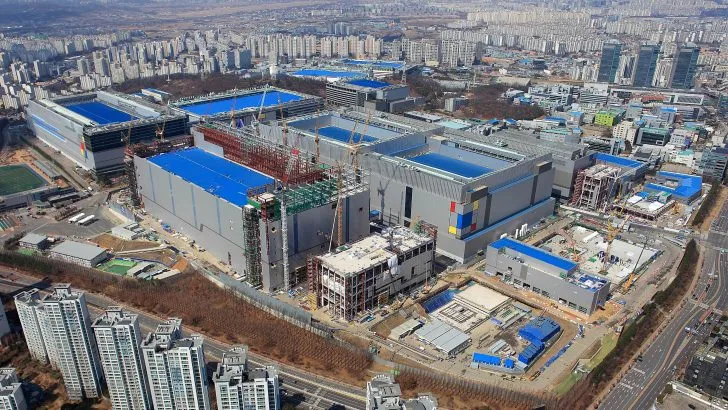
Samsung Electronics reported a record third-quarter operating profit of 107.4 trillion won, driven almost entirely by its semiconductor division, even as its shares fell after the results.
Samsung Electronics said on Thursday that its operating profit rose nearly ninefold to a record 107.4 trillion won in the third quarter, driven by robust demand for chips used in artificial intelligence systems. Revenue reached 195.3 trillion won, up 126.9 percent from a year earlier, while net profit rose 514.6 percent to 75.14 trillion won.
The semiconductor division did almost all of the work. Its Device Solutions unit reported revenue of 147.1 trillion won and operating profit of 106.5 trillion won, the first time the chip division has passed 100 trillion won in a quarter. Memory revenue alone reached 140.7 trillion won, up 427 percent from a year earlier, on surging demand for high-bandwidth memory and server DRAM. The finished-products division, which makes phones and home appliances, recorded an operating loss of 800 billion won, its second consecutive quarterly loss.
The results confirmed the preliminary guidance Samsung issued on October 8 and marked a fourth straight record quarter. They followed a record quarter from South Korean rival SK hynix a day earlier, and Samsung said the chip supply shortage would deepen next year, echoing its rival's outlook that tight memory supply could persist through 2027.
The won figures are consistent across the company's finalized results as reported by Aju Press and Seoul Economic Daily and the Reuters totals, with the chip division accounting for about 99 percent of group operating profit. Samsung also approved a third-quarter cash dividend of 30 trillion won, or 4,601 won per share. Despite the record, Samsung shares fell about 5 percent in Seoul trading on Thursday, with Aju Press attributing the pressure to the company deferring detailed shareholder-return plans until January.
The stakes are in how long memory pricing power lasts. Samsung and SK hynix are both telling investors that AI infrastructure demand has tightened supply faster than new capacity can arrive, which has lifted prices and margins to levels neither company had reached before. If that scarcity eases, the same operating leverage that produced a 55 percent group operating margin this quarter will work in reverse.
The next test comes in the fourth quarter, when Samsung expects HBM4 shipments and revenue to overtake the previous HBM3E generation, and in January, when the company is due to set out the remaining shareholder-return plans that investors were waiting for on Thursday.